
How SEO & AI Are Changing Journalism: Andrea Motta on the QdS Podcast
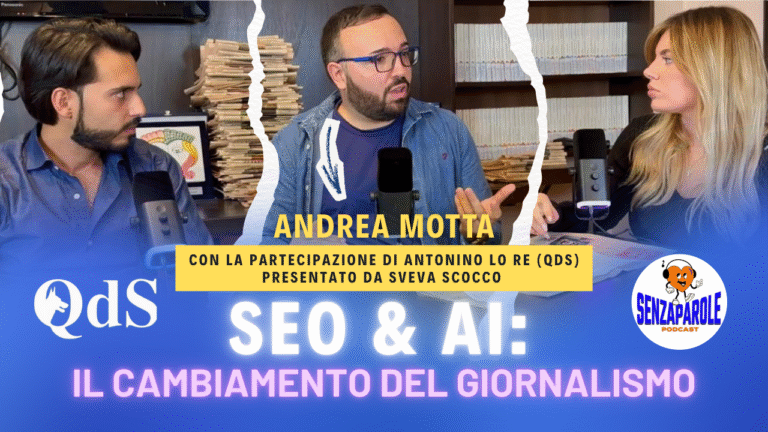
Andrea Motta, an SEO consultant with extensive international experience, was the guest of the tenth and final episode of the second season of Senza Parole Podcast, hosted by Sveva Adele Scocco in collaboration with Quotidiano di Sicilia.
The episode, available on YouTube and Spotify, also featured Antonino Lo Re, journalist and editor-in-chief at QdS, focused on a crucial topic undergoing deep transformation: how SEO, artificial intelligence and new technologies are changing journalism, information, and user behaviour.
Andrea Motta, an expert in SEO & AI, who recently spoke at the WordPress Meetup Catania on how SEO is changing in the age of AI – and who has just launched an online training dedicated specifically to SEO & AI – offered a clear and pragmatic overview of the direction we are heading in.
Table of Contents
How AI Is Changing Search: “From Query to Conversation”
After brief introductions, Andrea Motta opened the episode by exploring the impact of AI on the way we search for and consume information:
“I’m noticing two main changes. The first concerns the fragmentation of search. For years, Google held an almost absolute monopoly. Today, although it remains dominant, we are seeing significant growth in searches carried out via chatbots such as ChatGPT, Perplexity or Gemini. And we cannot ignore the fact that younger users now conduct their searches – from choosing a restaurant for the evening to deciding which trainers to buy – directly on Instagram and TikTok.”
The second change concerns the way we search:
“In the past, searches were ‘one shot’. Today, they develop as real conversations. Chatbots retain memory, provide context, and are able to return exactly what the user is looking for, even after some time.”
The Impact of AI on Publishers: Who Is Struggling and Why
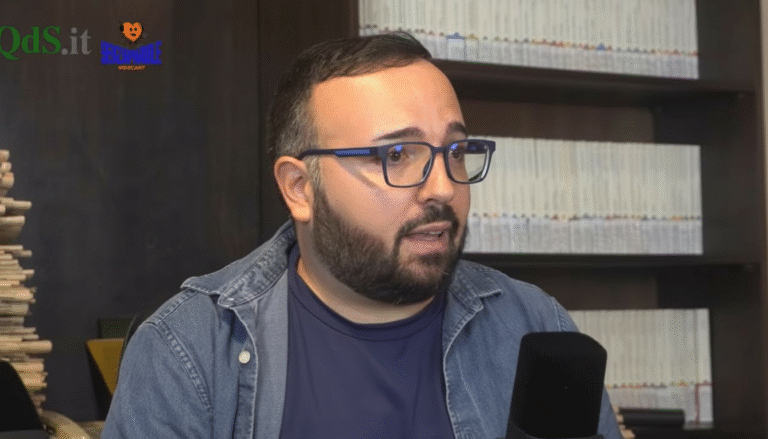
Asked whether there is a way to prevent AI from absorbing entirely publishers’ work, Motta explained:
“Not all sectors are affected in the same way. If you want to buy something on an e-commerce site, play at an online casino or place a sports bet, you still have to enter the website. But for publishers, especially for lifestyle content, evergreen pieces and tutorials, the situation is different. For example, almost no one opens a website any more to read a carbonara recipe or the steps to change an iPhone battery: you already have the answer in Google’s AI Overview, without needing to click through to the site. This, however, means fewer clicks on display ads, less advertising revenue and, as a result, reduced sustainability for many publishers.”
The Solution? Return to Quality
“The key to not being overtaken by AI is to focus on quality. News, exclusives, opinion pieces, in-depth analysis, podcasts: everything that an artificial intelligence cannot truly replicate. Journalism must raise the bar, not lower it.”
SEO Consultant Andrea Motta stresses that the problem did not start with AI, but with the race for clicks:
“Even before AI, many outlets started to fall in line with each other, copying one another and chasing clickbait headlines. Meanwhile, news farms proliferated, generating texts and images automatically from real articles. The answer cannot be to sink to that level.”
Can We Trust AI? It Depends on How It Answers
For Motta, trust is a central issue:
“AI systems go through an initial training phase in which they absorb millions of data points. After the ‘cut-off date’, to answer questions they need to connect to the web using RAG systems, and in those cases they show the source. And when there is a source, the user can verify it. The problem arises when the answer is not linked to any source. In that case you cannot know whether the information is accurate.”
Motta cites a now famous case:
“Through AI Overview, Google showed among the suggested ways of dealing with depression the reply of a Reddit user who suggested ‘jumping off the Golden Gate Bridge’ (see screenshot below). Therefore, I would say that extreme caution is needed.”

The Role of Newspapers in the Age of AI
According to Motta, newsrooms should not oppose progress, but integrate it intelligently:
“It’s right not to behave like dinosaurs. AI can speed up many editorial tasks. Google itself, in its guidelines, has moved from saying that content must be written by humans to saying that it must be authentic and add value. It no longer talks about who writes it. In short, what matters is content curation: AI-generated content, if carefully edited and reviewed by an editor, can absolutely rank in search engines.”
If you would like to explore how SEO and Artificial Intelligence can help your newsroom, blog or company grow online, Andrea Motta offers personalised consultancy, SEO audits and strategic support on the use of AI in content.
For information or consultancy requests, email Andrea Motta directly at me@andreamotta.net or submit a contact form.
